How to Write Multiple Choice Questions That Actually Test Understanding
A multiple choice question is only as good as its wrong answers. Anyone can write a correct answer. The skill is in the distractors, the incorrect options, and most multiple choice questions fail because the distractors are not actually testing anything. Here is a practical process for writing ones that do.
Start with what you want to measure
Before writing any wording, decide what a student who does not understand the concept would get wrong, and how. A question that just asks students to recognize a memorized fact is testing recall. A question built around a common misconception is testing understanding. Decide which one you actually want before you write a single answer choice.
Write the correct answer first, then work backward
Write the question stem and the correct answer as a clean, standalone statement. Only after that, write two or three distractors based on the specific ways a student gets this wrong: a common calculation error, a mixed-up term, a rule applied in the wrong context. Writing distractors this way keeps them grounded in real mistakes instead of random wrong facts.
What makes a distractor actually work
A good distractor has three properties:
- It reflects a real, specific misconception, not a random wrong fact a student would never actually believe.
- It is plausible to someone who has not learned the material, but clearly wrong to someone who has.
- It matches the correct answer in length, grammar, and level of detail, so nothing about its form gives it away.
You probably do not need four options
The traditional four or five option format is not a rule, it is a habit. Research reviewing decades of multiple choice testing has consistently found that three total options, a correct answer and two strong distractors, perform about as well as four or five, as long as every distractor is genuinely plausible. A weak fourth option that nobody picks does not add difficulty, it just adds writing time. Two sharp distractors beat three where one is obviously wrong.
A quick before and after
Here is the same question stem with the same correct answer, twice. The only thing that changes is the quality of the wrong answers.
Weaker distractors
Where does photosynthesis primarily occur in a plant, and what does it use? A. leaves/chlorophyll B. rock formation C. animal migration D. all of the above
Stronger distractors
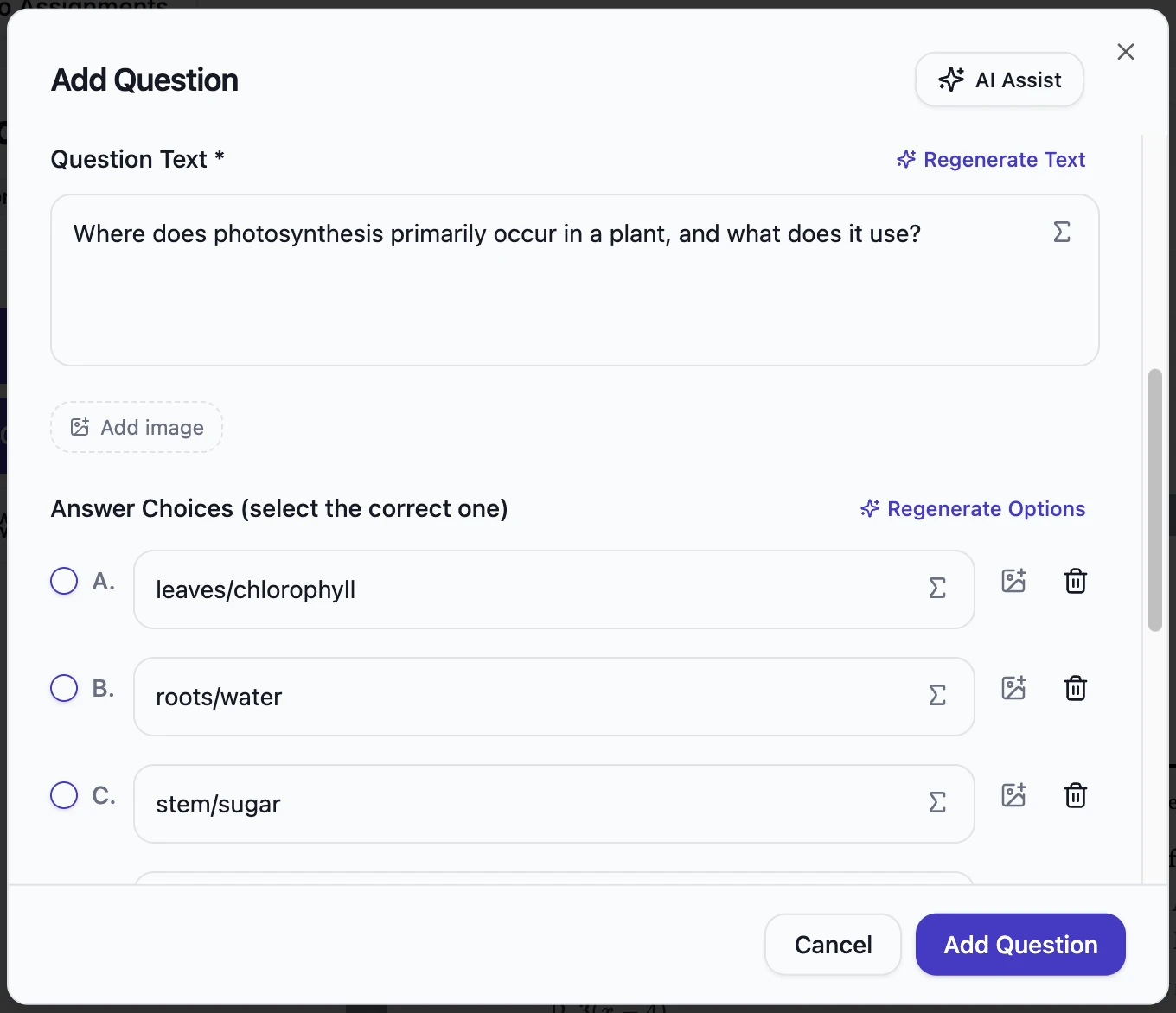
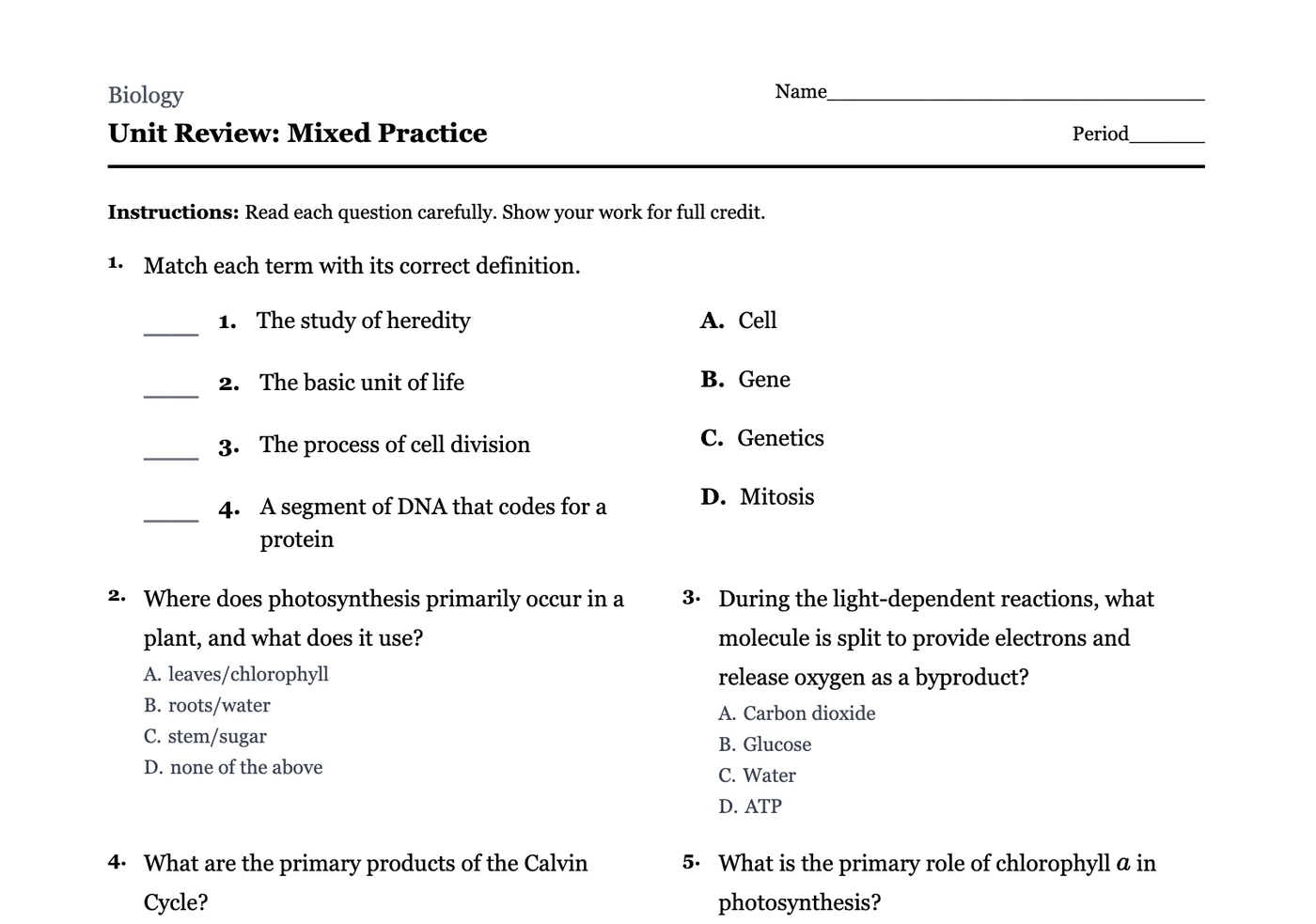
Where does photosynthesis primarily occur in a plant, and what does it use? A. leaves/chlorophyll B. roots/water C. stem/sugar D. none of the above
The question is identical and option A is correct in both. In the first version, no student who has sat through the lesson is choosing a rock formation or animal migration, so the question really only measures whether someone can rule out nonsense. In the second, each wrong answer is a plausible location paired with a real plant process, so a student who has confused where water is absorbed with where photosynthesis happens will actually pick B. Same question, but only the second one tells you anything about what a student understands.
A note on option D. "None of the above" only earns its place when students have reason to believe it could actually be the keyed answer. If you use it, use it across a set of questions and make sure it is genuinely correct on some of them. Used that way, it stops students from working backward by eliminating options and forces them to evaluate each statement on its own. Used as filler on a question where it is never correct, it is just a slot taking up space.
Common mistakes that give the answer away
- The correct answer is noticeably longer or more detailed than the distractors, a well-known tell for test-savvy students.
- Only the correct answer matches the grammar of the question stem (for example, the stem ends in "a" and only one option starts with a consonant).
- "All of the above" or "none of the above" dropped in as filler on a question where it is never the correct answer. Both can work, but only if students have real reason to think they might be keyed.
- Absolute words like "always" or "never" appearing only in the distractors, since students learn to associate absolutes with wrong answers.
- A phrase copied directly from the textbook or lecture appearing only in the correct answer.
Where AI helps, and where it does not
AI is genuinely useful for the first draft of distractors, generating a few plausible wrong answers based on a described misconception is exactly the kind of repetitive writing task it handles well, and it can save real time across a large question bank. What it cannot do reliably is know which misconceptions your specific students actually have. That judgment still has to come from you. Treat AI-generated distractors as a draft to review and sharpen, not a finished question.
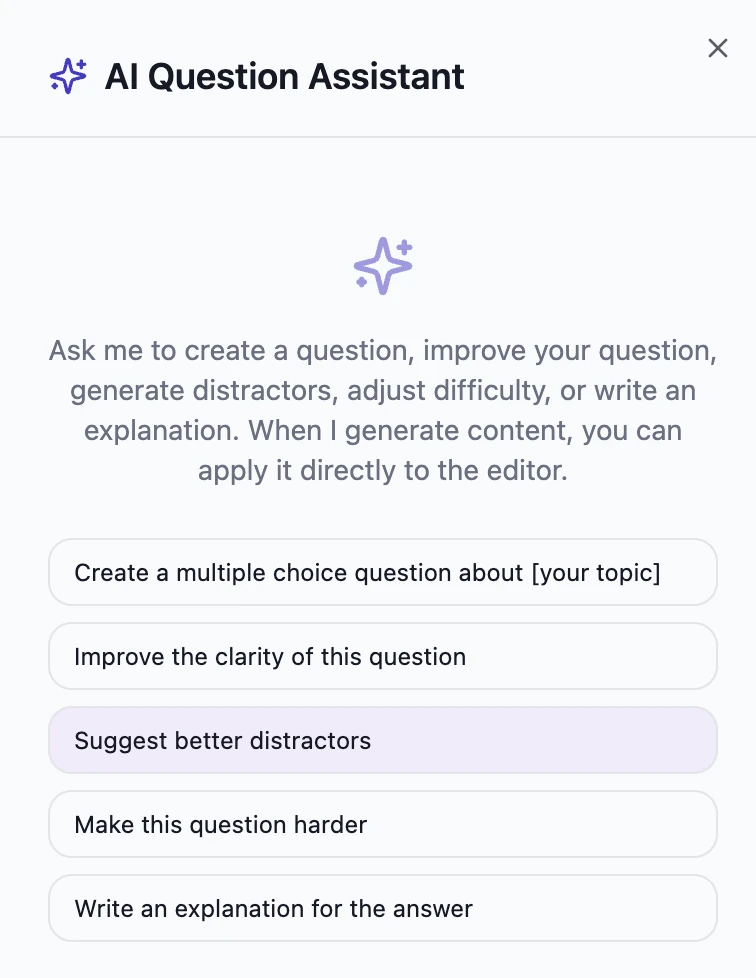
If you are building a question bank you will reuse across sections or semesters, it is worth setting these questions up so they can flex between formats. PraxiBuilder's bimodal question type lets a single question serve as either multiple choice or free response depending on how you assign it, and its AI assistant can draft a first pass at distractors from a description of the concept, which you can then edit before adding it to a bank.