The Modified True/False Question Is a Better Alternative to Plain True/False
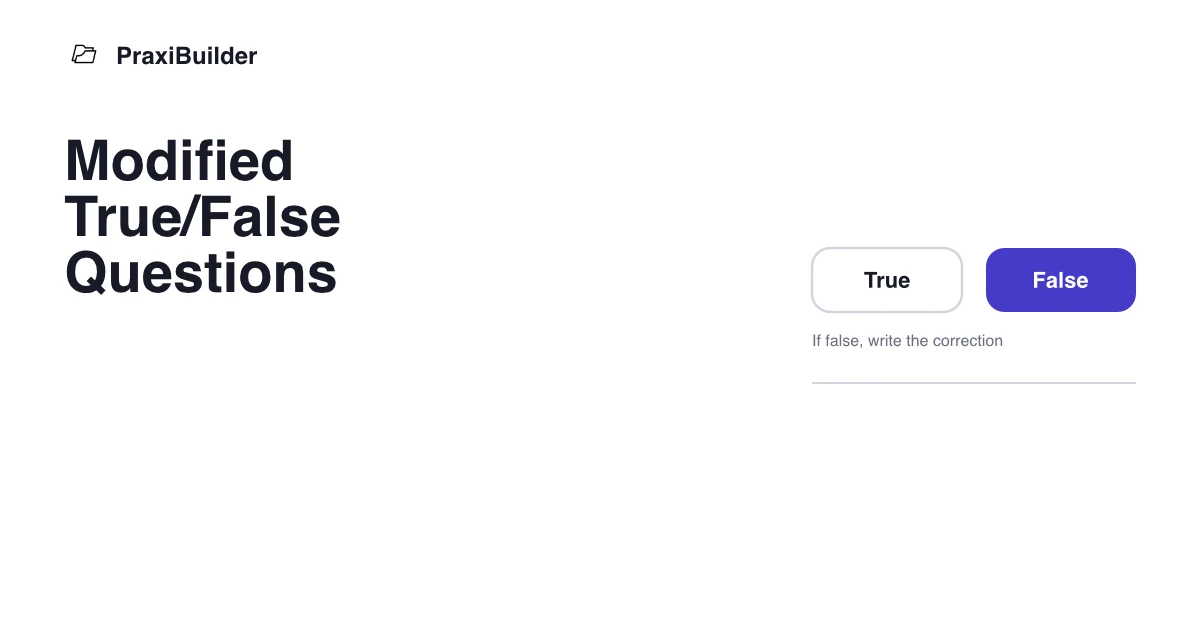
A true/false question has a structural problem no amount of careful writing fixes: a student with no idea what you taught still has a 50 percent chance of getting it right. Marking one box does not require producing any knowledge, only recognizing a binary. There is a simple fix that keeps the format but removes the guessing problem. It just requires a correction.
The problem with a coin flip
On its own, a true/false question cannot tell you whether a student knows the material or got lucky. Across a whole test the guessing washes out somewhat, but on any single item it does not, and students know it. A true/false section is often the fastest part of a test to finish precisely because it asks so little of the student who does not know the answer.
Require a correction, not just a guess
The fix is old and well documented. When a statement is false, the student has to write what would make it true. This is sometimes called a modified or corrected true/false item, and it changes what the question measures. Marking "false" is recognition. Supplying the correct fact is recall. A student who has only memorized that a specific statement is "the false one" without knowing why will mark it correctly and then fail to produce the correction, which is exactly the gap you want to catch.
Research on this format backs up the intuition. A 2021 study on true/false testing found that requiring students to correct false statements, with feedback afterward, improved retention of that material beyond simply marking it true or false. The format has also been studied as far back as the 1920s as a way to offset guessing without abandoning the speed and easy grading that make true/false attractive in the first place. Despite that, most test-building tools only offer a bare True or False toggle and stop there.
How this works in PraxiBuilder
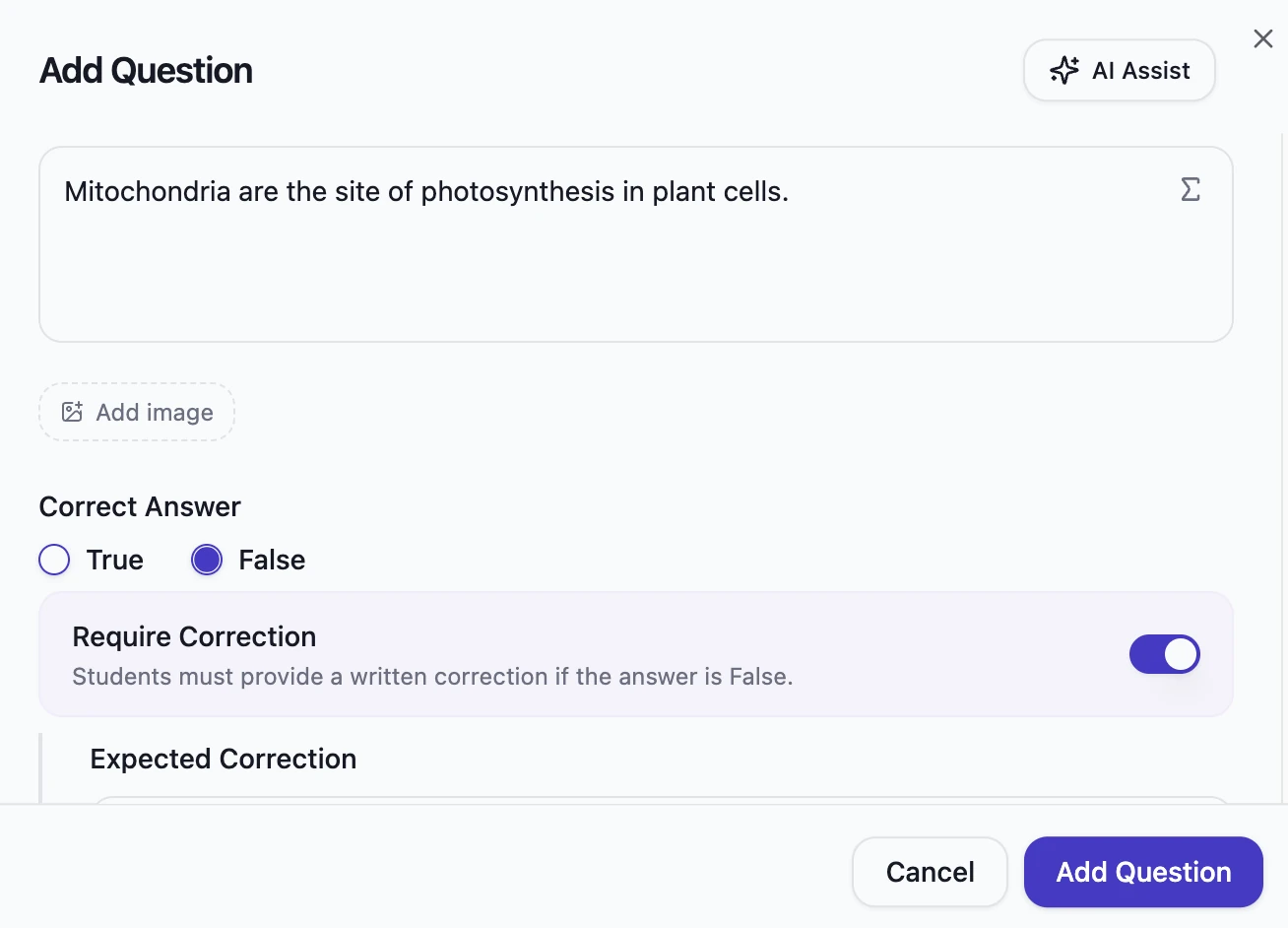
Any True/False question in PraxiBuilder has a "Require Correction" toggle. Turn it on and an "Expected Correction" field appears, where you write what a student should say to make a false statement true. Save the question and PraxiBuilder stores it as a Modified True/False question. Because the correction field uses the same math input as the rest of the app, the expected correction can be a written phrase or an equation, which matters if the "false" part of your statement is a formula or a number rather than a word.
On the printed exam, a modified true/false question looks like a normal True/False question, with one addition, a line reading "If False, write the correct answer" and a blank underneath it. Students who mark True skip it. Students who mark False have to fill it in, which is exactly the point.
A quick example
Here is a statement that is false in one specific, checkable way.
Modified true/false question
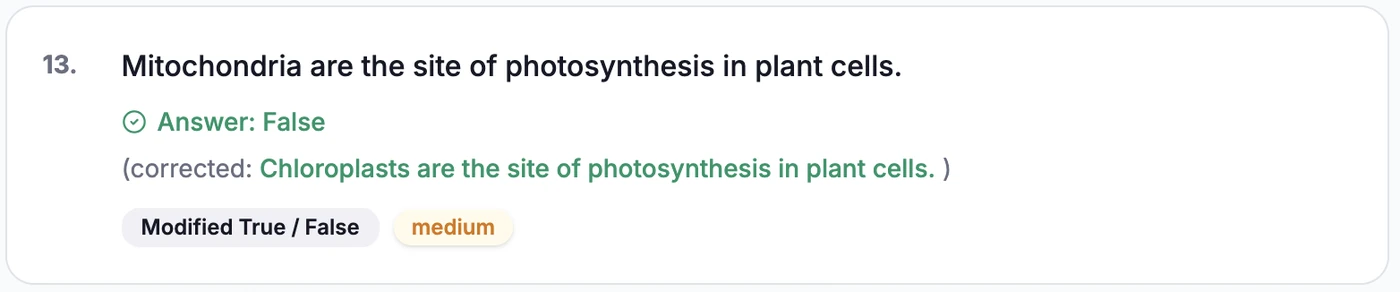
Statement Mitochondria are the site of photosynthesis in plant cells. Correct Answer False Expected Correction Chloroplasts are the site of photosynthesis in plant cells.
A student who has memorized "that mitochondria statement is false" without knowing what mitochondria actually do will mark it correctly and then have nothing to write, or will write something unrelated. A student who understands the distinction between mitochondria and chloroplasts will mark it false and supply the correction without hesitating. Same question, but only one version of "getting it right" actually required knowing the material.
Common mistakes with modified true/false
- Writing a statement with more than one questionable part, so a student who understands the material still cannot tell what you actually want corrected.
- Requiring a correction on a statement that is true. There is nothing to correct, so the field just confuses students and adds nothing to grading.
- Making the false part so vague that "the correction" could reasonably be several different facts. If more than one answer would fairly count as correct, the original statement needs to be narrower.
- Not deciding your grading standard before you assign the test. Because the correction is free text, decide upfront whether a reworded but equivalent answer counts, since your students will find creative ways to say the same thing.
Where AI helps, and why this format resists shortcuts
AI is useful for turning a true fact you already have into a matching false statement and correction pair, which is a fast way to build a bank of these once you have your source material. You still need to check that the false part is specific and that the expected correction is exact, since a vague pair defeats the whole point of the format. It is also worth noting that a modified true/false question is naturally harder to shortcut than a plain one. A 50 percent guess does not help with a blank correction field, and there is no answer choice to eliminate your way toward.
If you already have true/false questions in a bank, this is one of the fastest upgrades available. Turning on Require Correction does not require rewriting the statement, only deciding what the correct version should say.